

The Hidden Cost of Stalled Deals: Why Pipeline Value Can Be Misleading

Updated: Jul 7
Monthly Theme: Pipeline Reality
A full pipeline doesn't always mean a healthy pipeline. Opportunities can appear to be progressing while momentum quietly slows, forecasts become less reliable and commercial risk begins to grow beneath the surface.
Throughout this month, we're exploring why pipelines often create a false sense of confidence, how to recognise the hidden signs of Deal Drift™, and the practical steps organisations can take to improve forecasting, maintain momentum and drive more predictable commercial performance.
This Week's Insight: The Hidden Cost of Stalled Deals: Why Pipeline Value Can Be Misleading

Why Stalled Deals Are More Expensive Than You Think
Most organisations spend a great deal of time measuring the value of deals they win. Far fewer understand the true cost of the deals that don't move.
Stalled deals rarely appear on a profit and loss statement. They don't show up as a loss. They aren't recorded as a failed investment. Instead, they sit quietly in the pipeline month after month, creating the illusion of future revenue while consuming valuable time, resources and attention. This is one of the reasons deal drift is so dangerous. The cost isn't always visible but it is always there.
The Illusion of a Healthy Pipeline
A pipeline can look healthy on paper. Plenty of opportunities. Strong forecast numbers. Reassuring coverage ratios. Revenue targets that seem well within reach.
Yet beneath the surface, many of those opportunities may have stopped progressing entirely. Stakeholders are no longer engaged. Priorities have changed. Decision-making has slowed to a halt and momentum has quietly disappeared. The opportunity remains open, but it is no longer moving forward.
This creates a dangerous disconnect between what leaders believe is happening and what is actually occurring within the business and the result is often a deeply inflated view of future performance.
The Four Costs No One Is Counting
Cost #1: Sales Resource Drain
Sales resource drain is perhaps the most familiar cost, even if it goes unmeasured. Every opportunity requires attention and even when a deal has stalled, account teams continue investing time in meetings, follow-ups, internal reviews and forecasting discussions. The assumption is often that one more conversation, one more presentation, or one more proposal revision will unlock progress. Sometimes it does.
More often, it simply prolongs the situation. Over time, stalled deals consume a disproportionate share of sales capacity while delivering little or no return and when that pattern is multiplied across dozens of opportunities, the impact becomes significant.
Cost #2: Pre-Sales Burn
Pre-sales burn is where the real cost begins to accumulate for many partners. Before a deal closes, organisations invest heavily in discovery workshops, demonstrations, solution design, technical validation and proofs of concept.
These activities are essential for helping customers understand the value of a solution, but they are also expensive. Every hour invested by a sales engineer, consultant or solution architect represents real cost to the business.
When opportunities stall, that investment becomes trapped and the longer a deal remains inactive, the longer those resources remain tied to an opportunity that may never convert.
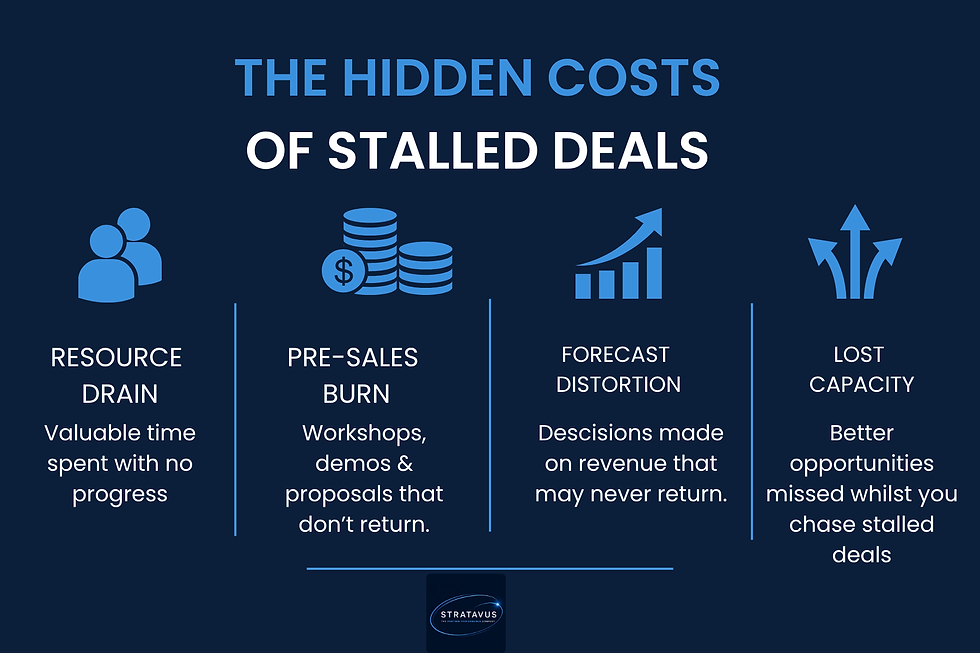
Cost #3: Forecast Distortion
Forecast distortion compounds these problems at the leadership level. Forecasting depends on one critical assumption: that the opportunities included in the forecast are progressing towards a decision. When stalled deals remain in the pipeline, that assumption becomes increasingly unreliable.
Leaders begin planning around revenue that may never materialise. Investment decisions become distorted. Recruitment plans are delayed or accelerated based on inaccurate expectations. The problem is not simply that forecasts become wrong, it is that important decisions are being made using information that no longer reflects reality.
Cost #4: Lost Capacity
Lost capacity is perhaps the biggest hidden cost of all, because it is the hardest to see. Every hour spent chasing a stalled deal is an hour that cannot be invested elsewhere. While teams focus on opportunities that are no longer progressing, new prospects receive less attention, active opportunities move more slowly, customer engagement suffers and win rates decline.
The true cost of a stalled deal is not just the revenue that may never arrive, it is the opportunities that were never pursued because resources were focused in the wrong place. High-performing organisations understand this and they recognise that protecting sales capacity is just as important as generating pipeline.
Why Deals Stall in the First Place
Most stalled deals are not caused by poor technology, weak proposals or ineffective delivery teams. More often, they are the result of deal drift — a gradual erosion of the conditions that made an opportunity viable in the first place.
At the beginning of an engagement, stakeholders are aligned around a common objective. There is clarity. There is momentum. There is a shared understanding of what success looks like. But as the deal progresses, small gaps begin to emerge. Stakeholders change. Priorities shift. Assumptions go unchallenged. Outcomes become less clearly defined. And momentum, almost imperceptibly, begins to slow.
Eventually, the opportunity remains open but no longer advances. The deal hasn't been lost. It has simply drifted. And because the drift happens gradually, organisations often fail to recognise it until months have passed.
What High-Performing Partners Do Differently
The most successful partners focus on more than pipeline volume. They focus on pipeline quality. Rather than simply tracking the value of opportunities in the pipeline, they pay close attention to indicators like stakeholder engagement, decision confidence, outcome clarity, buying momentum and the rate of progression through stages.

The question they ask is not "How much pipeline do we have?" but rather "How much of our pipeline is genuinely moving forward?" That shift creates a far more accurate picture of performance and allows organisations to identify risk earlier before stalled deals become a structural problem.
The Real Question Leaders Should Be Asking
Many leadership teams spend their time reviewing pipeline value. But pipeline value alone tells only part of the story. A more important question is: how much of your pipeline is actively progressing towards a decision? Because an opportunity that is not moving is not creating value. It is creating cost. And the longer it remains stalled, the greater that cost becomes.

The organisations that consistently outperform their competitors are not necessarily the ones with the largest pipelines. They are the ones that understand which opportunities are moving, which are drifting and where intervention is needed because pipeline value only matters when momentum exists.
Concerned that opportunities in your pipeline may be drifting? Download the Deal Drift Diagnostic™ to identify hidden risk, uncover stalled momentum and assess the health of your active opportunities — or book a Deal Performance Review for an independent view of where deals are slowing down and what action can be taken to recover them.
Stratavus helps technology partners create sustainable growth by improving deal performance, stakeholder alignment and customer outcomes.
Through our Knowledge Hub, practical frameworks, strategic consultancy and enablement programmes, we help partner organisations maintain momentum, reduce Deal Drift™ and deliver measurable business outcomes across the entire customer lifecycle.
Whether you're looking to improve a single opportunity or transform partner performance at scale, Stratavus provides the insight, structure and expertise to help you achieve lasting results.

Frequently Asked Questions
What is a stalled deal?
A stalled deal is an opportunity that remains active in the pipeline but is no longer making meaningful progress towards a decision. While conversations may still be taking place, key stakeholders are often disengaged, next steps are unclear, and momentum has slowed significantly.
Why are stalled deals dangerous?
Stalled deals consume valuable sales, pre-sales and leadership resources while creating little or no progress. They can distort forecasts, reduce team capacity and prevent organisations from focusing on opportunities that are more likely to close.
How do stalled deals affect forecast accuracy?
Forecasts become unreliable when stalled opportunities remain included as expected revenue. Because these deals are no longer progressing towards a decision, they create an overly optimistic view of future performance and increase the risk of missed targets.
What is the difference between a stalled deal and a lost deal?
A lost deal has reached a clear outcome and is no longer being pursued. A stalled deal remains open but has lost momentum. In many cases, stalled deals can remain in the pipeline for months before they are eventually won, lost or abandoned.
What causes deals to stall?
Deals rarely stall because of technology alone. More commonly, opportunities lose momentum when stakeholders fall out of alignment, priorities change, outcomes become unclear, or decision-making becomes delayed. This gradual loss of momentum is often referred to as Deal Drift™.
Common warning signs include:
No meaningful progress for several weeks
Repeatedly postponed meetings
Unclear next steps
Stakeholder disengagement
Slipping decision dates
Increasing internal discussions with little customer movement
These are often early indicators that an opportunity is drifting.
How can partners reduce the risk of stalled deals?
High-performing partners focus on maintaining stakeholder alignment, clearly defining desired outcomes, agreeing measurable success criteria and regularly validating decision momentum throughout the sales cycle.
Deal Drift™ is the gradual loss of alignment, momentum and stakeholder engagement within an opportunity. It often occurs long before a deal is lost and is one of the most common causes of stalled deals, forecast inaccuracy and poor pipeline health.
How often should pipeline health be reviewed?
Pipeline health should be reviewed continuously, not just at quarter end. Many organisations conduct monthly or quarterly forecast reviews but fail to assess whether opportunities are genuinely progressing. Regular reviews focused on momentum, stakeholder engagement and outcome clarity help identify risk much earlier.
Can stalled deals be recovered?
Yes. Many stalled deals can be recovered if the underlying cause is identified early. Re-establishing stakeholder alignment, clarifying desired outcomes and creating a clear path to decision can often restore momentum before the opportunity is lost.


Comments